
November 10, 2026 · 6 min read
Vendor Communication Timeline Template for Markets and Craft Fairs
A free vendor communication timeline template for craft fairs and markets: when to send acceptance, payment, insurance and load-in messages, and to whom.
A market can look fully booked on a spreadsheet and still be unprepared to open. The missing pieces usually surface late: an unpaid booth fee, an expired insurance certificate, an unsigned waiver, or a vendor who never received load-in details. A vendor communication timeline template gives each requirement a clear deadline and gives vendors a reliable answer to one question: what do you need from me next?
For craft fairs, artisan markets, and pop-up events, communication is not just promotion or customer service. It is the operating process that turns accepted applicants into ready-to-arrive vendors. The best timeline does not create more messages. It sends the right message when an action is due, with a clear place to complete it.
Why vendor communication breaks down before market day
Most organizers do not struggle because they forget to email vendors. They struggle because every vendor is at a different stage. One has applied but not been reviewed. Another has been accepted but has not paid. A third has paid but still needs to submit an insurance certificate. When those statuses live in separate inbox threads, spreadsheets, and payment tools, follow-up becomes reactive.
That creates predictable problems. Vendors receive broad reminders that may not apply to them. Organizers spend time checking who has completed what. Important instructions get buried beneath payment questions and application updates. By the final week, the event team is chasing documents instead of preparing the site, booth map, check-in process, and vendor arrival plan.
A timeline solves this by tying communication to operational milestones. Each message should either request a required item, confirm that an item has been received, or prepare vendors for the next stage of the event.
Build the timeline around vendor commitments
A useful vendor communication timeline template follows the commitments vendors make to participate. Start with the application. Then move through acceptance, booth payment, compliance documents, signed agreements, and event-day logistics. The order matters because a vendor should not be asked for every document at once unless your event has a very short lead time.
Your exact schedule depends on the size and frequency of the market. A monthly neighborhood market may work on a three- to four-week cycle. A large seasonal craft fair often needs two to six months, particularly when insurance requirements, juried applications, or multiple booth types are involved. The sequence remains the same even when the dates change.
At launch: publish application requirements
When applications open, tell vendors what is required to be considered and what will be required if they are accepted. Include the application deadline, booth categories, booth fees, selection timing, cancellation policy, insurance expectations, and waiver or vendor agreement requirements.
This first communication prevents a common issue: vendors assuming acceptance is automatic or learning about a required certificate only after they have paid. Be specific about whether insurance is required for all vendors, only food vendors, or vendors with a certain type of setup. If a certificate must name the venue or organizer as an additional insured, say so early.
Send a reminder midway through the application period only if applications are still open. Keep it focused on the deadline and the information needed for a complete application. Avoid promising a review date you cannot meet.
After selection: send acceptance and next steps
The acceptance message is the most important message in the process. It should confirm the vendor's placement and state the next required action, usually payment of the booth fee. It should include a firm payment deadline, the amount due, and what happens if payment is not received on time.
Do not combine acceptance with a long list of load-in rules, promotional requests, and final maps. At this stage, vendors need to know that their space is reserved only after payment. Clear sequencing makes it easier for them to act and easier for you to see who needs follow-up.
If you maintain a waitlist, communicate that separately. Waitlisted vendors need an honest status update and a response window if a space becomes available. They should not receive the same operational reminders as confirmed vendors.
After payment: collect documents and agreements
Once booth payments are in, request the documents that make participation official. Depending on the event, this may include an insurance certificate, a signed vendor waiver, a sales tax acknowledgment, a food permit, or a vendor agreement.
Give each item its own due date if the requirements are substantial. A vendor may be able to sign a waiver immediately but need time to request a certificate from an insurance provider. Setting one vague deadline for everything often creates a false sense of completion.
A good document request identifies the document, explains why it is needed, shows the deadline, and tells the vendor what a valid submission looks like. For insurance certificates, include the required coverage amount, certificate holder language, and any additional insured wording. That reduces the back-and-forth caused by certificates that are submitted but do not meet the event requirement.
Vendor communication timeline template
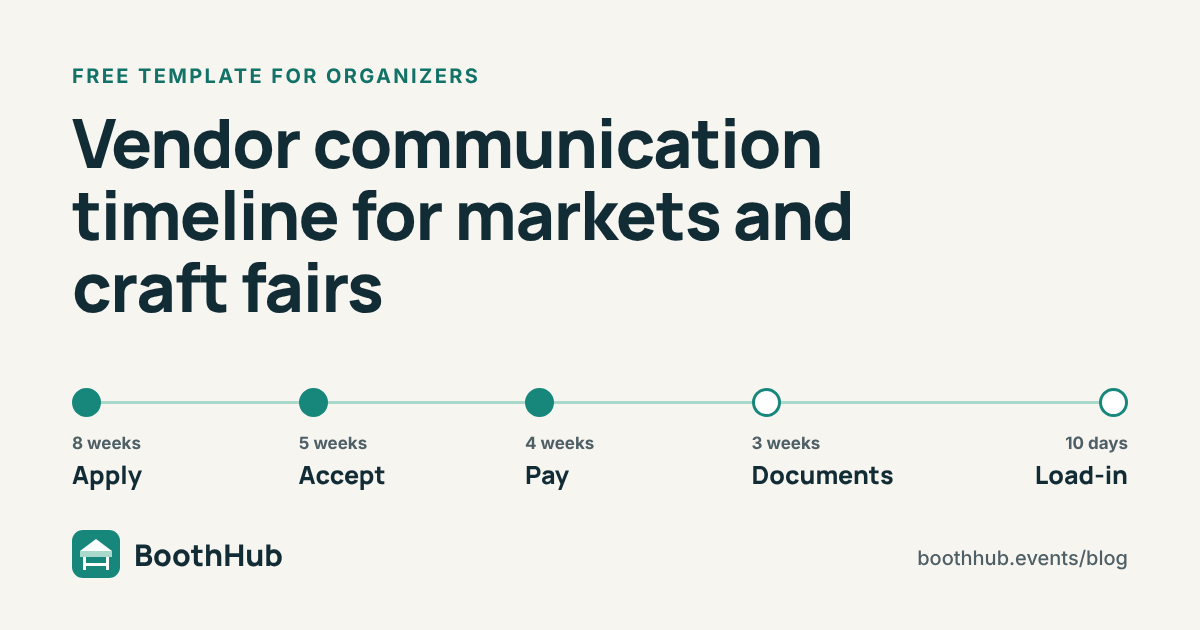
Use this sample as a starting point for a market with applications opening eight weeks before the event. Adjust the timing for your own review process and vendor requirements.
Timing Vendor status Communication purpose Required vendor action 8 weeks before Prospective vendor Announce applications and requirements Submit complete application 6 weeks before Applicant Remind vendors of application deadline Finish and submit application 5 weeks before Selected vendor Send acceptance, booth fee, and payment deadline Pay booth fee 4 weeks before Unpaid accepted vendor Send targeted payment reminder Complete payment or release space 3 weeks before Paid vendor Request insurance certificate, waiver, and required permits Upload documents and sign agreement 2 weeks before Incomplete vendor file Send item-specific compliance reminder Submit missing document or signature 10 days before Fully confirmed vendor Share load-in window, parking, booth location process, and event rules Review instructions and ask questions 3 days before Fully confirmed vendor Send final arrival reminder and organizer contact details Arrive prepared for check-in 1-2 days after Participating vendor Thank vendors and share next-event or follow-up details Provide feedback if requested
The table is a framework, not a reason to send every vendor every message. Payment reminders should go only to vendors with unpaid balances. Document reminders should go only to vendors with incomplete files. Targeted communication feels more professional and reduces the chance that vendors ignore messages because they assume they do not apply.
Keep final instructions separate from compliance follow-up
The final event message should be easy to find and easy to use from a phone. It should cover arrival time, load-in entrance, unloading rules, parking, booth setup boundaries, check-in location, event hours, weather policy, and the best day-of contact method.
Do not bury a missing insurance certificate notice inside that message. A vendor who is not cleared to participate needs a separate, direct communication with a deadline and the consequence of not completing the requirement. Mixing compliance issues with general logistics can create confusion at precisely the point when the organizer needs certainty.
In BoothHub, organizers can put arrival windows, parking, setup rules, the day-of contact and a map into one Day of Details packet. It goes to accepted vendors a week before the event, and anyone who already has it gets an update if something changes.
It also helps to distinguish between information vendors must read and actions they must take. A booth map may be informational. Signing a waiver is an action. Labeling the difference keeps urgent tasks visible.
Make ownership and records part of the plan
A timeline works only when someone owns each stage. For a small market, that may be one organizer. For a larger event, one team member may review applications while another tracks payments and another verifies certificates. Define who sends the message, who answers replies, and who marks a requirement complete.
The recordkeeping method matters just as much. If a vendor says they paid, signed, or sent a certificate, your team should be able to verify it without searching an inbox. A centralized system such as BoothHub keeps applications, booth payments, insurance certificates, and signed waivers attached to the vendor record, so communication can follow actual completion status rather than assumptions.
Set a final internal readiness check before sending load-in instructions. Review every confirmed vendor for payment status, required documents, signed agreement, booth assignment, and any special operational notes. If an item is missing, contact that vendor directly before the final event message goes out.
A well-run market feels calm because the hard questions were answered before vendors arrive. Build your communication timeline early, make each deadline visible, and give vendors one clear next step at a time. That is how the check-in table stays focused on welcoming vendors rather than solving preventable paperwork problems.