
November 7, 2026 · 7 min read
How to Choose Holiday Markets Worth the Booth Fee
How vendors can pick holiday markets that pay off: work out your break-even number, check the crowd, read the listing, and spot red flags before you pay a booth fee.
Every November, the same question lands in vendor group chats: which holiday markets are actually worth it? Applications are open everywhere, booth fees climb as December gets closer, and every organizer promises big crowds. Pick well and the season can carry your shop into spring. Pick poorly and you can spend a December weekend standing behind a table that barely covers its own fee.
The good news is that choosing holiday markets does not have to be a guess. A few numbers, a few questions for the organizer, and a careful read of the listing will tell you most of what you need to know before you pay a booth fee.
This guide walks through how to evaluate holiday markets for vendors, from working out your break-even point to spotting the warning signs that a market is not the right fit.
Start With Your Break-Even Number
Before you compare markets, know what a market has to do for you to come out ahead. Your break-even number is the amount you need to sell just to cover the cost of being there.
Add up everything the day costs you:
- The booth fee, plus any service or processing fees
- Gas, parking, and tolls
- Food for the day
- Any rentals, such as a tent, tables, or extra lighting
- Help, if you pay someone to work the booth with you
Then divide that total by your profit margin. If your products cost you about 40 percent of their price to make, your margin is about 60 percent.
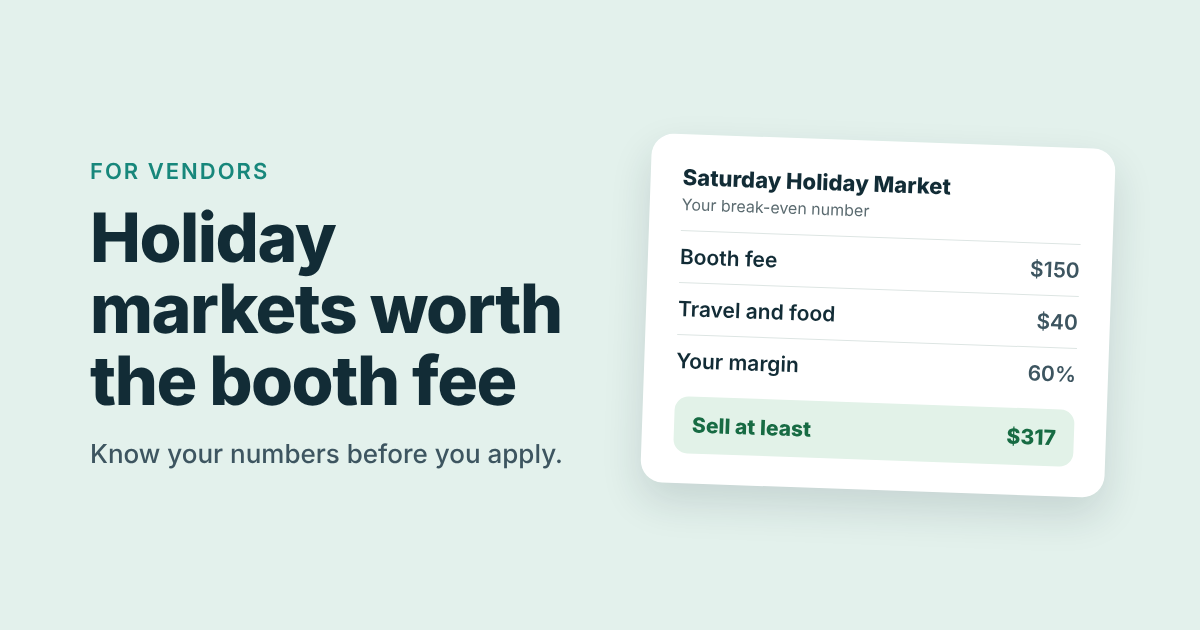
Example: a $150 booth fee plus $40 in travel and food is $190 in costs. At a 60 percent margin, you need to sell about $317 just to break even. Anything above that is profit.
Now look at the market differently. Instead of asking "is $150 a lot?", ask "can I realistically sell $317 here, and how far past it can I go?" A $75 market where you would sell $250 can be a worse day than a $200 market where you would sell $900.
If you have sold at markets before, your past sales are the best guide. If you are new, be conservative and assume a slower first year at any market.
Look at Who the Market Draws, Not Just How Many
Organizers love to share attendance numbers, and foot traffic matters. But the right crowd matters more than the biggest crowd.
Ask yourself who is walking through the door. A free community festival may draw thousands of people who came for music and food. A smaller ticketed holiday market may draw fewer people who arrive specifically to buy gifts. For many handmade sellers, the second crowd spends more.
Questions worth asking the organizer:
- How many shoppers came last year, and how do you count them?
- Is entry free or ticketed?
- How are you promoting the market this year, and where?
- What kinds of vendors did best last year?
- How many vendors will there be, and how many in my category?
That last question is important. Ten candle makers in one room means ten booths splitting the same candle shoppers. Organizers who limit how many vendors they accept in each category are protecting your sales as much as their own.
Match the Market to Your Products and Price Points
A market can be busy and still be wrong for you. Think about what the typical shopper there spends and whether your products fit.
If your best sellers are $15 to $30 stocking stuffers, a high-traffic market with a broad audience is often a strong fit. If you sell $200 pottery or fine jewelry, a juried market with a gift-buying crowd may do better, even with fewer shoppers.
Holiday shoppers also buy differently than summer browsers. They are looking for gifts, so items that are easy to give do well: things that are ready to wrap, come in a range of price points, and are easy to carry home. If you can offer a few gift-friendly items at a lower price, you widen the number of markets that make sense for you.
Read the Listing Like a Contract
The details in a market listing tell you what you are really paying for. Before you apply, check:
- Booth size and what is included. Is a table provided? A chair? Power? An indoor spot near the entrance is not the same as an outdoor spot at the far end.
- Dates and hours. A two-day market is two days of standing, staffing, and inventory. Make sure the fee makes sense for the time it asks of you.
- Setup and breakdown times. Early setup times and late breakdowns add hours to your day.
- Requirements. Many markets ask for liability insurance, a signed waiver, or a sales tax permit. Factor in the cost and time of getting these if you do not have them yet.
- The cancellation and refund policy. Plans change, especially in a busy season. Know how much notice you need to give to get a refund or a credit, and whether a weather cancellation means you get anything back.
A clear, written policy is a good sign. It usually means the organizer has thought through the details.
Single Day, Multi-Week, or Consignment?
Holiday season offers more formats than a typical summer weekend, and each one carries a different kind of risk.
Single-day markets are the simplest to try. If a market is new to you, one day is a low-commitment way to test it.
Multi-week markets run on several weekends or weekdays through the season. They can build momentum, since shoppers come back and start to recognize your booth. Many let you pick just the weeks you want, and some offer a discount if you book every week. If a market has done well for you before, booking more of the season can lower your cost per day.
Consignment and shelf space in a holiday shop is a different option altogether. You stock a shelf, the shop sells for you, and you usually pay a flat fee, a commission, or both. You do not have to staff a booth, which makes it a good way to reach holiday shoppers on days you are selling somewhere else.
Mixing formats can spread out your risk. One or two single-day markets, a multi-week market you trust, and a consignment shelf can make a steadier season than betting everything on one big weekend.
Check the Organizer
A great market is usually run by a great organizer. Signs you are in good hands:
- They answer questions quickly and clearly.
- Their listing has real details, not just a date and a price.
- They have a promotion plan and share it.
- Other vendors speak well of them.
- They have a clear refund policy and stick to it.
Ask vendors you know whether they have done the market before. Most will tell you honestly whether it was worth it. On BoothHub, a green check next to a market means BoothHub has reviewed that organizer, which is one more way to know a listing is legitimate.
Red Flags to Watch For
Some warning signs are worth taking seriously:
- No information about past attendance or how the market will be promoted
- Booth fees well above similar markets in your area with no clear reason why
- Pressure to pay immediately, before you have been accepted
- No written refund or cancellation policy
- Vague details about the location, booth size, or what is included
- Far more vendors than the space or the expected crowd can support
None of these automatically rule a market out, but they are good reasons to ask more questions before you pay.
Build a Season You Can Actually Work
The most profitable holiday season is not necessarily the one with the most markets. Back-to-back weekends drain both your inventory and your energy, and a tired booth sells less.
As you choose markets, look at your calendar as a whole:
- Leave time between markets to restock.
- Make sure you can make enough inventory for every market you book.
- Prioritize the markets with the best expected return, then fill in around them.
- Keep one or two weekends open for last-minute opportunities.
After each market, write down your sales, your costs, and a few notes about the crowd. By next season, you will have your own data on which markets are worth returning to, and that is more valuable than any attendance number an organizer can give you.
Find Holiday Markets Near You
Holiday markets fill up quickly, so it helps to see your options in one place. On BoothHub you can browse markets by date to see what is happening each weekend, check booth sizes, prices, and requirements in each listing, and apply directly. For multi-week markets, you can pick every week you want in one step.
Choose the markets that fit your products, your prices, and your calendar, and the holiday season can be your best stretch of the year.
If you are a market organizer, you may also find our guides to vendor application management and booth rental management helpful.